The History of Mushrooms: Ethnomycology, Ancient Ritual & Medicine
Part two of a series. If you haven't read the introduction on healing with medicinal mushrooms, start there.
The Fungi Kingdom exists everywhere on this planet. On land, in water, in the air, on plants and animals and humans too. They range from the microscopically tiny to the largest organisms on Earth, spreading across several kilometers of forest floor. And they have been here a long, long time.
This piece is about that time. About what we know of the relationship between fungi and human beings, and how little of it we actually know.
What Is Ethnomycology?
Ethnomycology is the study of the historical uses and sociological impact of fungi. It takes in medicine, food, myth, shamanic and spiritual practice, and the long human relationship with psychoactive mushrooms.
It is a small field, studying a very old subject. Despite fungi having lived on this planet for an extraordinary span of time, we know only a fraction of their history. The interwoven stories of fungi and humans are ancient and mostly unwritten. For as long as we have lived, we have lived beside them.
How Old Are Mushrooms?
The oldest fossil mushroom we have found is Gondwanagaricites magnificus. It grew roughly 115 million years ago, in what is now northeastern Brazil, back when the supercontinent Gondwana was breaking apart. It somehow fell into a saline lagoon, sank through layers of salt water, and was slowly mineralised into stone.
Every other fossil mushroom we have ever found was preserved in amber.
The mushrooms in your garden are not far removed from the ones a dinosaur would have walked past.
Mushrooms in the Archaeological Record
Fungi decay fast. They rarely leave a trace. So the record of our relationship with them lives less in fungal remains than in what we made about them — the paintings, the carvings, the things we carried. Here is where they surface.
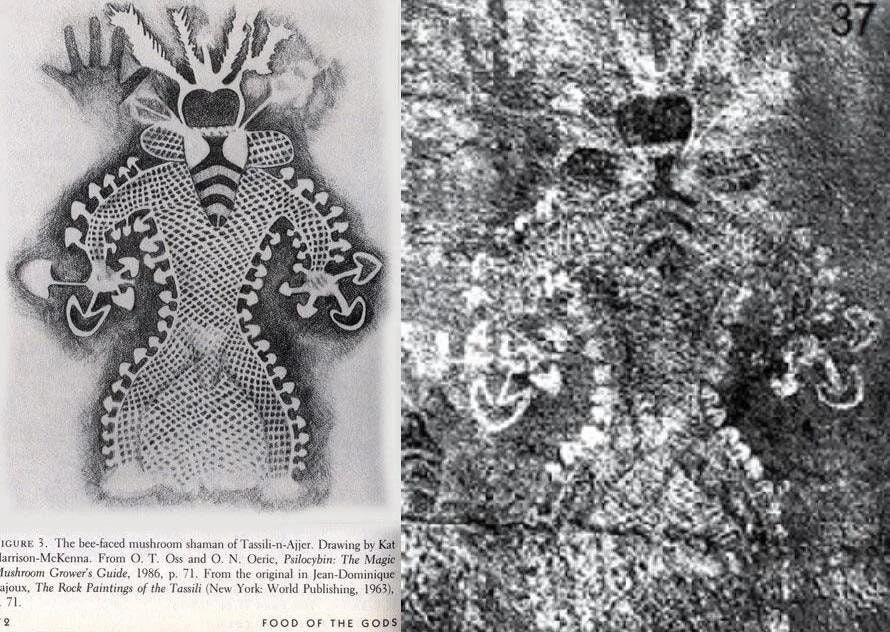
Tassili n'Ajjer, Algeria
Deep in the Sahara, in a UNESCO World Heritage site holding more than fifteen thousand prehistoric paintings and engravings, there are figures with rounded caps rising from their heads and shapes scattered around their bodies.
They are commonly called the Tassili mushroom figures, and they date to somewhere between seven and nine thousand years ago, to a period when the Sahara was green savannah rather than desert.
Whether they depict mushrooms at all is genuinely contested. The reading was popularised by the ethnographer Henri Lhote and later by Terence McKenna, and the ethnobotanist Giorgio Samorini has argued they are the oldest physical evidence of psychedelic mushroom use. Other researchers don't find the fungal reading convincing. Recent scholarship cautions against mapping our categories of "shaman" and "ritual" onto images made by people whose world we cannot access.
What we can say is that people were painting them.
Ötzi the Iceman
In 1991, a body emerged from melting ice in the Ötztal Alps, on the border of Italy and Austria. Europe's oldest natural human mummy, dead for more than five thousand years.
Among his belongings were two species of polypore fungus. One, birch polypore, was threaded onto leather strips and worn around his neck. It has known anti-parasitic properties, and Ötzi was carrying a whipworm infestation, which has led researchers to think he may have been treating himself. The other, a tinder fungus, sat in his belt pouch alongside flint and pyrite — a fire-lighting kit.
Medicine and fire, carried on the body.
The Mushroom Stones of Mesoamerica
Hundreds of carved stones from the highlands of Guatemala and the Pacific piedmont show human and animal figures—jaguars among them—with mushroom caps growing from their heads.
The archaeologist Stephan de Borhegyi catalogued them in the 1950s and dated their earliest appearance to around 1000 BCE. Roughly three thousand years old. He proposed they were evidence of a ritual culture built around psychoactive fungi.
It is a hypothesis, and a compelling one. A cache of nine miniature mushroom stones found at Kaminaljuyu was buried alongside nine miniature grinding stones, which suggests something was being ground.
The word for mushroom worship is mycolatry.
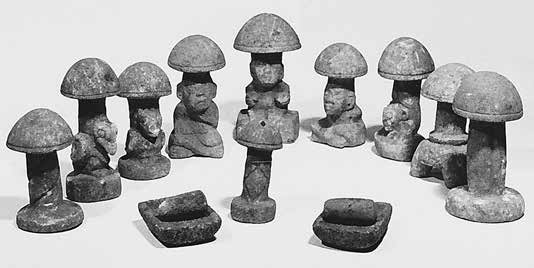
Carved stones in the shape of mushroom-people/animals
Chinese Medicine
Mushrooms have been used in traditional Chinese medicine for at least two thousand years, in both herbal and nutritional applications, for well-being and longevity.
The Shennong Bencao Jing, a foundational Chinese pharmacological text, describes six colors of zhi—the mushroom we now call lingzhi, or reishi. Green, red, yellow, white, black and purple. Each was believed to nourish the qi of a different part of the body: green for the liver, red for the heart, yellow for the spleen, white for the lungs, black for the kidneys, and purple for the essence, the jing.
Modern research into reishi is ongoing and, so far, mixed. There is reasonable evidence for its effects on immune markers. It is an old medicine that we are only beginning to study properly, and it deserves neither dismissal nor overclaiming.

Lingzhi mushroom aka reishi
Mushrooms Are Having a Moment
Mushroom teas, elixirs, powders, chocolates and coffee have sprouted through the health aisles. There is an annual festival in Telluride, Colorado devoted to psychedelic, culinary and medicinal mycology.
Denver became the first American city to decriminalise psilocybin, in May 2019. The legal picture has moved considerably since. Colorado and Oregon now run licensed, regulated psilocybin services, and New Mexico has passed a medical psilocybin law. Psilocybin remains a Schedule I substance under United States federal law.
Research has moved too. Johns Hopkins opened its Center for Psychedelic and Consciousness Research in 2019 with seventeen million dollars in private funding, making it the first of its kind in the country. It now operates with considerably more, and studies psilocybin for conditions including depression, addiction and anorexia nervosa.
If you are curious about working with psilocybin intentionally rather than recreationally, Soul Sustenance is where I hold that work—microdosing paired with somatic practice, so that whatever surfaces has a body to land in. I also hold small ceremonies and 1:1 retreats on request.
Why This Matters
Over and above the fact that all of this is fascinating—and if you have read this far, you are certainly interested—it is clear that mushrooms have played a monumental role in human life. Lifting cultures into altered states of consciousness. Keeping us free of parasites. Keeping us warm with fire.
It seems then that without mushrooms, we wouldn't be here.
Continue Your Journey
Read:Healing with Medicinal Mushrooms — part one of this series
Read more: Psychedelics and eating disorders
Explore:Soul Sustenance, intentional microdosing with somatic support
Join:EARTH, a free monthly online eatimg disorder recovery support group
Download:Free resources, including a microdosing course
Work with me:1:1 Somatic Coaching
References
Heads et al. (2017), "The oldest fossil mushroom," PLOS ONE — journals.plos.org
Akers et al. on the Tassili figures, and Samorini's counter-argument — see Atlas Obscura's overview
Peintner et al. (2008), "The Iceman's fungi," Journal of Ethnopharmacology
Borhegyi, S. F. (1961), "Miniature Mushroom Stones from Guatemala," American Antiquity
Jin et al. (2016), "Ganoderma lucidum (Reishi mushroom) for cancer treatment," Cochrane Database of Systematic Reviews
Johns Hopkins Center for Psychedelic and Consciousness Research — hopkinsmedicine.org
Mycelium is Medicine zine, Harmonic Mycology
Photo by Tania Alieksanenko on Unsplash