How to Prepare for a Plant Medicine Ceremony in Eating Disorder Recovery
Eating disorder recovery brings us into contact with all kinds of teachers, arriving at poignant moments along our path of uncovering, discovering, and recovering. If we move through life with a beginner's mind and the mantra "sometimes a student, sometimes a teacher," anyone and anything can become a teacher, including ourselves. Over the years, some of the teachers I have met have been sacred plant medicines, where the classroom is the ceremony space.
If you have arrived here, you may be considering that work for yourself, and wondering whether it is safe, how to prepare, and where to even begin.
This post is about preparation: what to put in place before ceremony, how to set an intention, and how to integrate afterwards. It is written from lived experience and grounded in what current research does, and does not, tell us.
Can plant medicine support eating disorder recovery?
The honest answer is: the research is early, and promising, and not proof of anything yet.
Anorexia nervosa is notoriously difficult to treat. It carries one of the highest mortality rates of any psychiatric illness, and there are currently no medications approved by the US Food and Drug Administration to reverse its core symptoms. That treatment gap is part of why researchers have begun looking at psychedelics at all.
In 2023, a team at UC San Diego published the first modern trial of psilocybin therapy for anorexia nervosa in Nature Medicine. Ten adult women received a single 25mg dose of psilocybin alongside psychological support. The study found the treatment was safe and tolerable, with no clinically significant changes in heart tracing, vital signs, or suicidality. Some participants described the experience as meaningful. 90% endorsed feeling more positive about life endeavours; 80% endorsed the experience as one of the top five most meaningful of life; and 70% reported experiencing a shift in personal identity and overall quality of life.
It is important to hold this carefully. This was a Phase 1 feasibility study, designed to test safety and tolerability, not whether the treatment actually works. The authors themselves describe the therapeutic effects as "preliminary." So while these early signals are genuinely hopeful, plant medicine is not a proven treatment for eating disorders, and it is not a replacement for the care of a treatment team.
I share this because clarity is its own form of respect, for you and for the medicine.
Safety first: screening and contraindications
Before any preparation practices, the most important groundwork is safety. Sacred does not mean risk-free. If you are considering ceremony, please treat the following as non-negotiable.
Get medically screened. Reputable practitioners and clinical trials screen carefully before anyone works with these medicines. Classic psychedelics temporarily raise heart rate and blood pressure, so serious or uncontrolled cardiovascular conditions, including significant heart disease, uncontrolled high blood pressure, or a history of stroke, are considered contraindications. A history of seizure disorders and pregnancy is also a contraindication.
Talk about your medications. Many antidepressants interact with psychedelics. MAOIs affect the same serotonin system these medicines act on, which raises the risk of serotonin syndrome, a rare but potentially dangerous reaction. This is never something to manage alone or quickly. Any decision about medication belongs with the prescribing professional who supports you, with attention to safe tapering and psychiatric stability throughout.
Screen for psychiatric risk. A personal or family history of psychosis or bipolar disorder is generally considered a contraindication for classic psychedelics, because these medicines can occasionally trigger prolonged and destabilizing states in vulnerable people.
Know what plant medicine is not. Ceremony is not a substitute for eating disorder treatment. For many people in recovery, especially at a low weight or in a medically fragile state, the safest and most supportive next step is stabilizing care first. Plant medicine, if it has a place at all, tends to belong further along the path, not in the acute stage.
Good screening is what makes depth possible. It is the container that lets you go inward knowing your body is held and safe.
The dieta question
Some medicines, like Ayahuasca, call for a specific diet in the days or weeks before the ceremony, often called a dieta. For someone in eating disorder recovery, this deserves real and careful thought, not an automatic yes.
For me personally, when I was more actively struggling with anorexia, I chose to forgo changing what I ate before ceremony. In the past, restricting or altering my food ahead of a journey was triggering and had compromised both my intentions and my energy as I walked into the space. What was framed as sacred preparation quietly reactivated the very patterns I was there to heal.
If you are in recovery, a pre-ceremony dieta is not a neutral instruction. It can look, to a recovering nervous system, exactly like restriction. My encouragement is to make this decision with support, alongside a coach, therapist, or facilitator who understands eating disorders, rather than on your own or under pressure from a lineage or a facilitator who does not know your history. There is nothing spiritually inferior about protecting your recovery. Sometimes the deepest preparation is refusing to abandon yourself.
Preparing for the journey
Once safety and screening are in place, there are gentle practices that can bring awareness to your intention and a sense of calm to your nervous system before ceremony. You might explore some or all of these:
Write a letter from your recovered, ED-free future self to your present self. What would they want you to know now?
Practice Nadi Shodhana Pranayama (alternate nostril breathing) for a few minutes in the morning or before bed.
In your journal or meditation, communicate with the plant allies as if they were sitting beside you. What questions do you have for the medicine? What fears or concerns are present? What would you like to see, learn, or uncover? In what ways can you begin giving thanks now?
Reflect on five feelings you wish to call more into your life. Practice conjuring them in your body. How does it feel to embody these desired feelings?
Create or refresh the altar in your room, as a way of marking that a new chapter is beginning.
Practice an anchoring body scan meditation, so you know how to safely resource yourself in your own body before you need to.
These are ways to train the body, heart, and mind, and to begin the relationship with the medicine before you ever enter the space.
Why setting an intention matters
An intention is focused energy, directed toward a specific place. Spending time forming one brings clarity, encourages honest self-inquiry, and begins the conversation with the medicine before you enter the room. During ceremony, with the support of the plants and the group, that intention has room to move and deepen.
Inside the journey
Psychedelics appear to work in part by loosening rigid patterns of connectivity in the brain's default mode network, the system associated with our habitual sense of self and our most well-worn mental loops. Altered connectivity in this network has been observed across a range of mental health conditions. For someone whose inner world is governed by control and rigidity, this temporary loosening can open an unfamiliar and sometimes freeing experience of letting go. Surrender may not come easily, and the medicine often offers many opportunities to practice trust, release, and being in the flow of the moment.
The journey also gives your voice a place to be heard. This is not a one-sided engagement. There is room to ask questions to the medicine, to say no, to set a boundary, to ask to be shown something again, or to say you are not ready to face a particular theme. This can be profoundly empowering. So many of us working through eating disorders have dimmed ourselves, restricted our truth, swallowed our expression, and not allowed ourselves to ask for help or state a desire. Ceremony is co-created, and you are worthy of expressing yourself, with the plants and beyond.
A few things worth carrying in with you: the breath as an anchor, a mindset of compassionate inquiry, humility, and resilience, and attention to your set and setting. Return to whatever you established in preparation, recalling your intention throughout, or bringing an element of your altar into the space. An anchoring meditation is a good tool for meeting a difficult moment and returning to a felt sense of safety and grounding.
Integration: turning insight into daily life
Insight is only the beginning. Integration is the slow work of letting what you glimpsed become how you live.
I used to believe it was impossible for anyone to be free of their eating disorder. After years of telling myself this, I thought, "What if?" What if it is possible to no longer punish, control, restrict, or harm my body?
What if it is possible to feel my emotions, to sit in my body and connect with my breath without running away?
What if it is possible to celebrate my vulnerabilities with others, express my sexuality without shame, to speak up and stand in my power?
When I realized this was all possible, and that recovery is possible, the work with the plant medicine found integration through a renewed sense of empowerment. I felt more inspired to weave the plants' teachings into other healing modalities on an ongoing basis.
It was with this shift in belief that my recovery accelerated. I was no longer limited. This shift, this insight, actually changed my behaviours and my actions, because I now knew recovery was within reach.
For anyone in eating disorder recovery, it can take a long time for actions to match thoughts, and longer still for beliefs about recovery to shift. Even with the help of plant medicine, where insight can arrive so clearly and simply, ingrained patterns often persist once ordinary life resumes. Integration is a continuous, lifelong process, and this is just as true in eating disorder recovery.
Some ways to continue your integration:
Distill the main messages from your journey into concrete, actionable steps.
Work regularly with an integration coach, an eating disorder coach or therapist, or speak to someone who simply gets it.
Find a psychedelic integration circle, in person or online, that can hold you accountable to those steps.
Establish a grounding morning practice: journaling, meditation, breathwork, movement, music, whatever brings you into rooted, inspired alignment.
Spend time in nature, connecting with the elements.
Consider introducing a gentle microdosing practice into your week.
Stay with the process. Be patient. Every day is integration day.

Community, sitting together in a cacao ceremony in Nicaragua doing breathwork and meditation
You are the ceremony
You carry a sacred temple with you in every moment, and that temple is your own body. You live right in the heart of it, and within it, you create the ceremony of your life. Through your body, life can become a practice of cultivating presence. And in that presence, this very moment becomes sacred, filled with gifts, gems, messages, and signs. You make the ceremony, whether you are in a mushroom, ayahuasca, or cacao ceremony, or simply in the ceremony of daily life.
Every step walked, every word spoken, every gesture made forms the ceremony that is your life. Every day is a ceremony, because you are the ceremony.
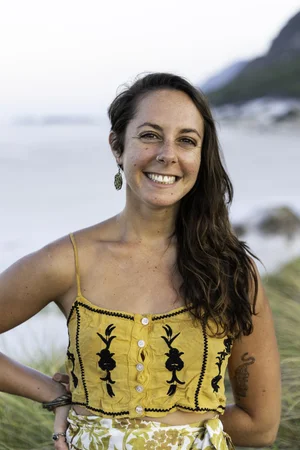
All photos in this article were taken at a beautiful cacao ceremony on Ometepe Island, Nicaragua, in 2020. We drank the cacao medicine, painted symbols on one another with seeds from the achiote tree, and danced.
Continue Your Journey
If you feel called to prepare for ceremony, or to integrate an experience you have already had, this is the heart of my work.
Work with me 1:1. I offer personal preparation and integration support for people navigating plant medicine in the context of eating disorder recovery. Together we can build the container, clarify your intention, and turn insight into lasting change. Learn about 1:1 coaching.
You might also explore:
Free microdosing course — a gentle introduction to microdosing as an integration practice, on my downloads page.
Ceremony and small 1:1 retreats — intimate, held space for deeper work. Reach out to explore this with me.
EARTH (A Place to Land) — a free monthly online drop-in support group for anyone in recovery. Join us here.
How To Host Your Own Cacao Ceremony — if you would like to read more about creating ceremony space. Read the post.
With love,
Francesca Rose 🌹