Riding the Storm: Somatic Skills for Times of Change
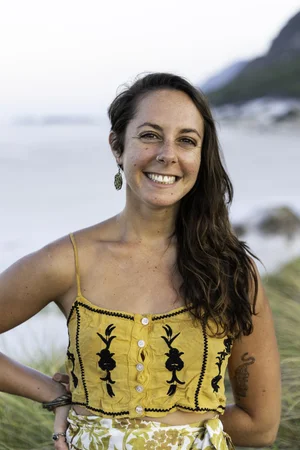
I’m writing this from the depth of winter in South Africa—bundled up, slowed down, listening closely.
After a few weeks in the brightness and movement of a Northern Hemisphere summer, finishing up a training with The Embodied Recovery Institute and attending a family wedding, returning home has felt like entering a different season entirely. And it’s not just the weather, but an internal storm, too.
I know I’m not alone in this.
Many people I work with describe a similar feeling: far out at sea. Old reference points no longer hold. Questions around direction, belonging, and meaning surface more insistently. And when political, economic, and ecological instability swirl around us, it’s no wonder our nervous systems feel the strain of stormy seasons.
What Is a Storm, Really?
Pause for a moment.
When you hear the word storm, what arises first in your body? An image? A sensation? A feeling?
For many, storms evoke violence, destruction, chaos, or danger. But the deeper roots of the word tell a different story.
The word storm can be traced back to the Proto-Indo-European (s)twer—meaning to stir up, to turn, to propel.
A storm, at its core, is not just destruction. It is movement, an activation, and a force that disrupts stagnation.
Across cultures and time, storms were understood as living intelligences—beings of immense power and agency. In mythology, they were often deified: Horus, the Egyptian god of the sky and rainstorms, associated with justice and order; or Poseidon, ruler of the seas, storms, and earthquakes, protector of sailors and keeper of balance between worlds.
Storms appear not only in myth, but in dreams, initiations, and rites of passage—symbols of forces that exceed our capacity to control.
They remind us of something essential: We cannot prevent all storms, but we can learn how to move through them.
The Art of Navigation
For as long as humans have lived close to land and sea, we’ve been students of navigation—both literal and metaphorical.
Storms shape us. They strip away what can’t hold. They force adaptation. And when met with skill, they often redirect us toward something more aligned, more alive.
As my teacher Rachel Lewis-Marlow, co-founder of Embodied Recovery Institute, once said:
“How we ride storms impacts how we land on the shore.”
So what helps us ride them?
Below are four somatic navigation skills I’ve come to trust, shaped through lived experience, recovery, and deep listening to the body.
Navigation Skill #1: Perception
Tibetan Buddhist teacher Chögyam Trungpa Rinpoche famously said:
“Chaos should be regarded as extremely good news.”
This doesn’t mean storms are easy or that we bypass their difficulty. It means that how we perceive the storm directly shapes our capacity to move through it.
When we meet disruption with curiosity rather than collapse, something softens. Perspective widens. The nervous system finds a little more space.
This widening of perception—seeing beyond the narrow frame of fear—is something somatic practice (and psychedelic experiences) can teach us. How to expand our relationship with the thing we are relating to (including our own fear).
Navigation Skill #2: Honesty
Storms often intensify when we ignore what we already know.
There’s usually a truth we’ve been avoiding—a change we sense is needed, a boundary that wants to be named, a longing that won’t stay buried.
In When Things Fall Apart, Pema Chödrön writes:
“Pointing to our own hearts to discover what is true isn’t just a matter of honesty, but also of compassion and respect for what we see.”
Honesty isn’t about self-attack or urgency. It’s about listening inwardly—through sensation, emotion, and felt sense—and compassionately allowing clarity to emerge at the body’s pace.
When we stop fighting what we know, the internal storm often begins to quiet.
Navigation Skill #3: Clarity (and Boundaries)
One of the most disorienting aspects of internal storms is losing our sense of self.
People-pleasing, masking, fawning, or shape-shifting in response to others can leave us feeling unmoored—like we’re steering someone else’s ship far out at sea.
At the root is often disrupted interoception (our ability to sense internal cues) and proprioception (our sense of where we are in space), showing up as a lack of clear physical or emotional boundaries, difficulty perceiving wants, needs, and physical cues (and relying on others for direction), or extreme rules and rigidity.
Cultivating clarity is the slow, embodied process of restoring an inner compass—shifting from external rules to internal guidance.
It’s a strengthening of the body’s capacity to contain, filter, and define experience.
I often think of it like kneading dough or shaping clay: a tactile knowing that I exist, I have edges, and I can step into my authentic embodiment.
As Chris Bache, author of LSD and the Mind of the Universe, asks:
“Do you have the courage to do what is only yours to do?”
Clarity grows from that courage. And courage grows from clarity.
Navigation Skill #4: Compassion
I would add compassion as the skill that holds all the others.
Fear is a natural response to change. As Pema Chödrön reminds us, fear often arises when we move closer to truth.
Rather than trying to eliminate fear, we can learn to meet it with warmth—to notice our reflex to pull away, without judgment.
Compassion allows us to stay present through uncertainty, without abandoning ourselves.
After the Storm
Every storm ends.
Rain gives way to light. Leaves fall and become soil. What looked like destruction often becomes the ground for new growth.
Nature is regenerative, adaptive, resilient, and creative.
And because we are nature too, these qualities live within us.
Those who learn (again and again) to ride storms with perception, honesty, clarity, and compassion don’t just survive change. They are shaped by it.
May we remember, in turbulent times, that storms are not here to punish us but to stir us awake.
Continue The Journey
Join: EARTH, a monthly free eating disorder recovery support group
Connect: If you enjoyed reading this, subscribe to my newsletter for (almost) monthly shares about the weather and so much ;)
Read: You’re not failing at healing, you’re healing inside a broken world (blog post)